Round Furniture Table: Small-Room Buying Guide
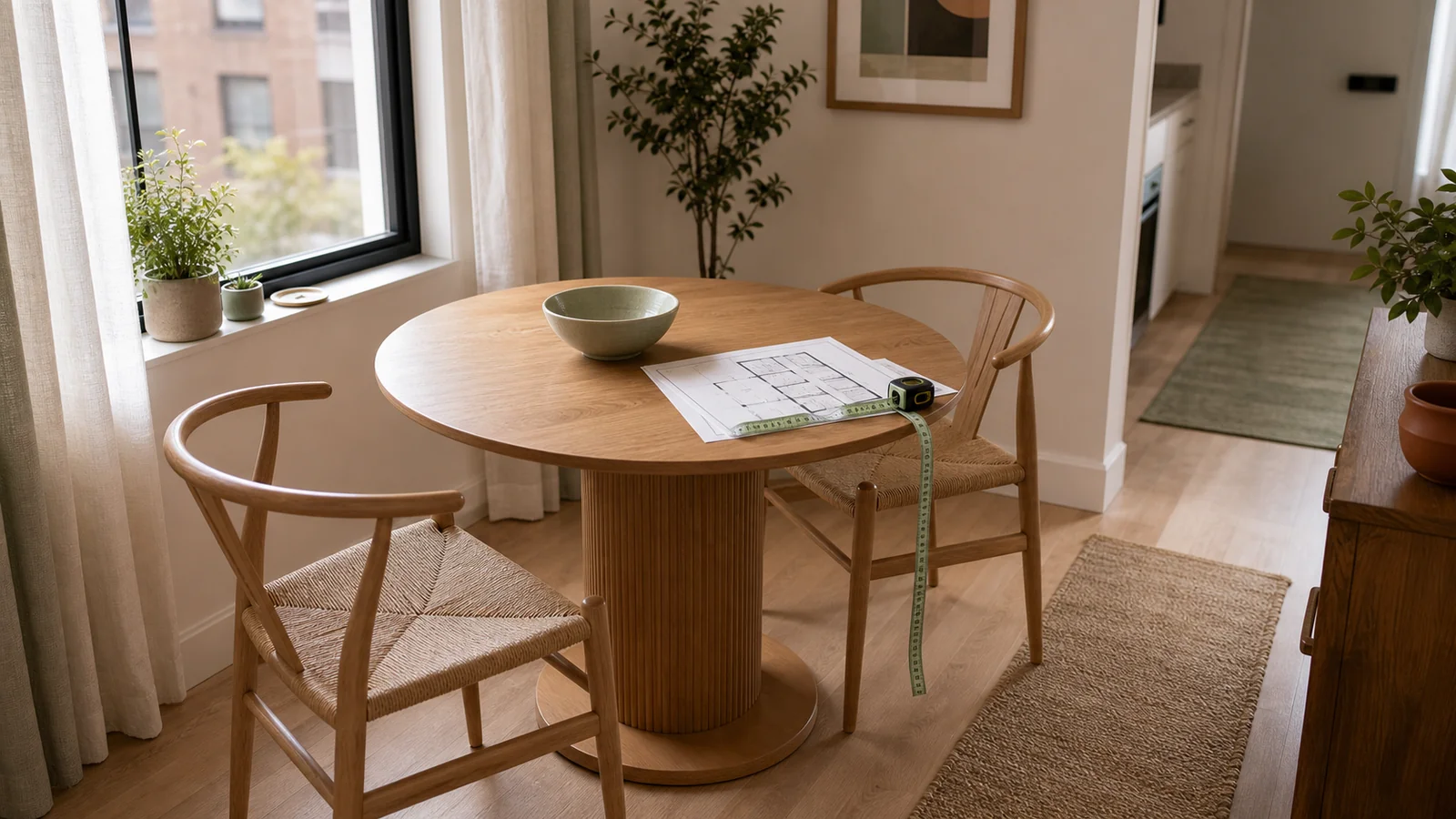
A round table can make a small room feel less boxed in
A round furniture table is often a gentler choice when a room has too many corners already. It can soften a square dining nook, make a studio apartment feel easier to cross, and let people slide around the edge without catching a hip on a sharp corner. That does not mean every round table is small-space friendly. Diameter, base style, chair depth, and walkway clearance matter as much as the tabletop shape.
The best round table for a compact room is not simply the smallest one you can find. It is the one that lets you sit comfortably, pull out chairs, walk past the setting, and keep the room calm when the table is not in use.
Use this guide as a practical buying check before you commit to a table that looks charming online but feels crowded at home.
Start with the people, then choose the diameter
Round tables are usually described by diameter. That single number can be misleading because it tells you the tabletop size, not the whole footprint once chairs and people are included.
For most compact homes, these ranges are useful starting points:
| Table diameter | Often works for | Best small-room use |
|---|---|---|
| 30 to 32 inches | 2 people | Breakfast corner, studio dining, work-from-home side table |
| 36 inches | 2 to 3 people | Apartment dining nook with slim chairs |
| 40 to 42 inches | 3 to 4 people | Everyday dining if the room has decent clearance |
| 48 inches | 4 people | Small dining room, open-plan corner, occasional guests |
| 54 inches and up | 5 or more people | Usually better only when the room is truly dedicated to dining |
If you rarely seat four people, do not buy a four-person table only because the listing promises it. A smaller round table with comfortable chairs will feel better than a larger top that forces every meal into a squeeze.
Measure the full circle of use
The table itself is only the quiet center of a larger circle. Chairs need to pull back. Knees need room. Someone needs to walk behind a seated person. Doors, radiators, balcony sliders, and cabinet fronts still need to open.
Before buying, tape the tabletop circle on the floor. Then place chairs, boxes, or folded towels where the chairs will sit. Walk the route you use most: kitchen to table, table to sofa, hallway to window, desk to kitchen. Carry a plate or laundry basket while you test it. A layout that works only when you walk sideways is too tight for daily life.
If you are still uncertain about the room’s larger clearances, our guide to measuring a room for furniture is a helpful first pass before you compare table styles.
Pedestal bases are useful, but not always magic
Many shoppers look for a pedestal base because it removes corner legs and gives chairs more freedom. In a small room, that can be genuinely helpful. You can often tuck chairs closer to the table, shift seats slightly between meals, and avoid the awkward moment when a chair leg fights a table leg.
Still, check the base carefully.
A good pedestal base should feel stable when someone leans on the edge. The foot should not be so wide that chair legs hit it. The column should leave enough knee room for the way people actually sit. A sculptural base can be beautiful, but it may steal space below the table even when the top looks compact.
Legged round tables can also work, especially when the legs are slim and set close to the edge without blocking chairs. They may feel lighter than a heavy pedestal in a very small room. The right choice depends on the whole under-table shape, not the label.
Match chair shape to the table, not the showroom photo
A round table can fail because of the chairs. Deep upholstered chairs, flared arms, wide backs, or splayed legs can make a modest table feel oversized. In a compact room, chair depth is often the hidden number that decides whether the table works.
Look for chairs that:
- Slide under the apron or tabletop cleanly.
- Have backs low enough to keep the room visually open.
- Do not have arms unless the room can spare the width.
- Feel comfortable without needing extra cushions.
- Have legs that do not tangle with the table base.
If you already own chairs, measure them before shopping for the table. A 42-inch round table can feel easy with slim cafe chairs and cramped with deep dining chairs. The table and chairs are one system.
Decide what the round table has to do every day
Some round tables are dining tables. Others become work surfaces, puzzle spots, coffee stations, entry tables, craft tables, or landing places for keys and mail. The more jobs the table has, the more carefully you need to choose material, height, and finish.
For daily meals, choose a surface that wipes clean without making every placemat feel precious. For laptop work, avoid a heavily textured top that makes writing uncomfortable. For a rental dining nook, consider a table that can move through narrow stairs and elevators. For an open-plan living area, choose a finish that speaks quietly with the coffee table, shelves, and sofa legs nearby.
Round tables are especially good when the room needs flexible movement. They are less ideal if you need to push one flat side against a wall every day. A drop-leaf table, small rectangle, or console may serve that kind of room better.
Watch the edge, apron, and visual weight
The edge detail changes both comfort and mood. A thick tabletop can look grounded, but it may make a small room feel heavy. A thin beveled edge can feel lighter and easier to live with. A sharp square edge looks clean but may be less pleasant in a tight path where people brush past the table.
Check the apron too. The apron is the frame just below the tabletop. If it is deep, it can reduce knee space and stop chairs from tucking in. This matters most on smaller diameters because every inch under the table is already working hard.
Visual weight also comes from color. Dark wood can be beautiful in a pale room if the table is simple and the chairs are light. Pale oak, ash, white, or soft painted finishes often make the table feel quieter. Glass can open the view, but it shows fingerprints and can feel cold if the room already has hard surfaces.
For a broader furniture decision, our contemporary furniture guide explains how open legs, quieter finishes, and lower visual weight can help compact rooms feel calmer.
Use round tables carefully in mixed-use rooms
In a studio or open-plan apartment, a round table often sits between several zones. It may separate the kitchen from the sofa area, mark the dining spot near a window, or act as a soft pause beside a bookcase. That can work beautifully, but the table should not become a traffic island.
Leave one side of the room visually quieter. Keep the chairs consistent. Avoid placing a round rug, round table, round pendant, and round mirror all in the same tight corner unless the scale is very controlled. Repetition can look styled in a photo and busy in real life.
If the table is near the sofa, compare its shape with nearby living-room surfaces. A round dining table beside a round coffee table can feel pleasing or repetitive depending on distance. Our cocktail table guide can help if the living area also needs a softer table shape.
Check quality before you fall for the silhouette
A round table has fewer corners to inspect, but it still needs a careful quality check.
Look for:
- A level top with no wobble.
- A base that does not rock on your floor.
- Smooth seams where leaves, veneers, or edges meet.
- A finish that suits real meals, cups, and cleaning.
- Hardware that can be tightened if the base loosens.
- Delivery dimensions that fit through stairs, doors, and elevators.
If the table extends with leaves, test the mechanism and ask where the leaves store. Some round extension tables become oval, which may be useful for guests but changes the room’s clearance. Do not assume the extended shape fits just because the everyday circle does.
When a round furniture table is the wrong answer
Round is not automatically better. A rectangle may work better along a wall, behind a sofa, or in a narrow galley-style dining area. A square table may feel neater in a square breakfast nook. A small oval can be the better compromise when you want softened corners but need more usable length.
Be cautious with a round table when:
- The room is very narrow.
- One side must sit flat against a wall.
- You need to seat four people every day in limited space.
- The only available chairs are deep or wide.
- The base blocks knees.
- The table will also hold large monitors, sewing machines, or other equipment.
The right table shape is the one that respects the room’s pressure points. Softness is useful only when it still leaves you space to live.
A calm final check before you buy
Before ordering a round furniture table, pause on the full setting rather than the product image alone.
Ask:
- Does the diameter match the number of people who eat here most days?
- Can chairs pull out without blocking the main path?
- Does the base leave knees and chair legs free?
- Does the edge feel comfortable in a tight room?
- Does the finish suit meals, work, and cleaning?
- Can the table move into the home without drama?
- Does it make the room feel softer, not fuller?
A good round table should make a small room easier to move through and kinder to sit in. When the size, base, chairs, and clearance all agree, the shape does what it is supposed to do: it gives the room a useful center without making every day feel crowded.
You might also like
Cocktail Tables Furniture: Choose the Right Size
Choose cocktail tables furniture by sofa scale, walkway clearance, shape, storage, corners, and everyday use in small rooms.
Console Table Furniture: A Small-Room Fit Guide
Choose a console table with the right depth, height, storage, and placement so narrow rooms stay useful and calm.
Ashley Furniture Mattress: Small-Bedroom Guide
Choose an Ashley Furniture mattress by checking size, height, support, delivery terms, and how the bed fits your room.