Dog Crate Furniture for Small Rooms: What to Check
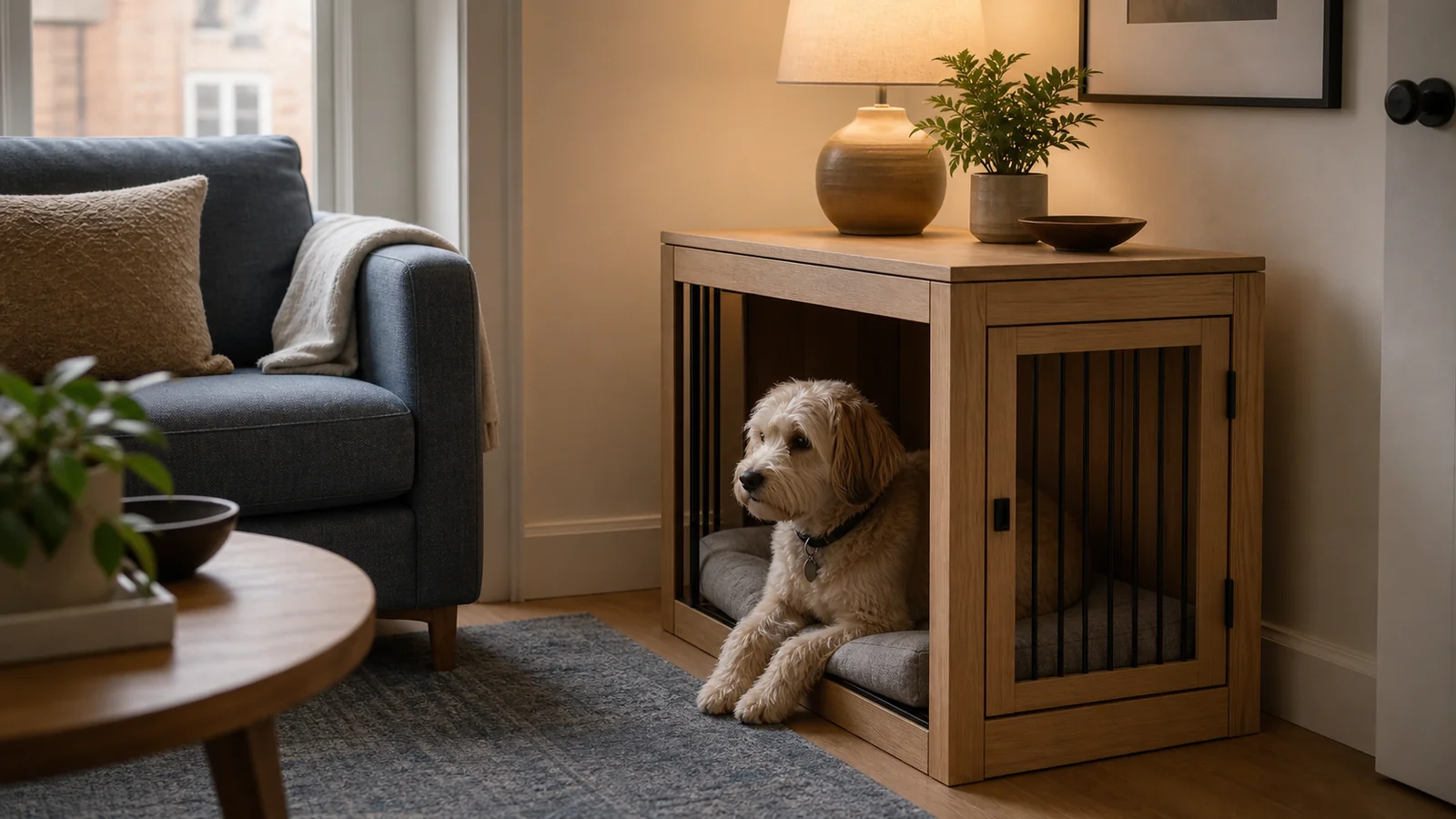
Treat the crate as comfort first, furniture second
Dog crate furniture can be a smart answer when a wire crate takes over the living room, bedroom, or office corner. The best versions give your dog a safe resting space while working as an end table, console, low cabinet, or nightstand. The worst versions look tidy online but feel cramped, hot, hard to clean, or awkward to use every day.
Start with the dog, not the room styling. Your dog should be able to stand, turn around, lie down naturally, and settle without pressing against the sides. Many crate sizing guides suggest adding a few inches to your dog’s standing height and body length, but the exact fit still depends on breed shape, coat, age, and how your dog rests.
If your dog is still growing, recovering from anxiety, or not crate trained yet, a furniture-style crate may not be the first piece to buy. A simple wire crate can be easier to move, clean, divide, and use during training. Once your dog already treats the crate as a calm place, a furniture version becomes a design decision instead of a training shortcut.
Measure the dog and the furniture footprint
Dog crate furniture has two sizes to check: the inside space for your dog and the outside footprint for your room. A crate can technically fit your dog while still being too deep for a narrow living room.
Measure your dog while they are standing and sitting. Record their body length, shoulder or head height, and the way they usually curl or stretch. Then compare those numbers with the interior dimensions, not only the overall product dimensions. Thick tops, side panels, decorative bases, and raised legs can reduce usable interior room.
For the room, tape the outside footprint on the floor before you buy. This is especially useful if the crate will sit:
- Beside a sofa as an end table
- Under a window in a bedroom
- Along a hallway wall
- Near a desk in a home office
- In an open-plan studio where every piece is visible
If you have not mapped the room yet, use our guide to measuring a room for furniture before comparing crate styles. The crate needs enough space for the door to open, for your dog to enter calmly, and for you to remove bedding or a tray without dragging everything into the walkway.
Check airflow, visibility, and temperature
Furniture crates often have more solid surfaces than wire crates. That can look calmer in a soft living room, but it can also reduce airflow and visibility. Look closely at the sides, back, and door.
Open slats, metal bars, mesh panels, or wide cutouts usually work better than tiny decorative openings. Your dog should be able to see enough of the room to feel included, and air should move through more than one side. This matters in warm apartments, sunny rooms, and homes without strong air conditioning.
Avoid placing the crate directly beside a radiator, heater, fireplace, hot window, or air vent. Also avoid tucking it under heavy curtains that can block air or tempt chewing. A crate that doubles as a table still needs the same environmental care as any other dog resting spot.
If your dog has a thick coat, runs warm, pants easily, or dislikes enclosed spaces, choose a more open design. A visually heavier crate may suit the room, but your dog may do better with more airflow and less enclosure.
Choose doors and latches for daily use
Door placement decides whether dog crate furniture feels effortless or annoying. A front door may work beside a sofa. A side door may work better when the crate sits along a wall. Double-door designs can help when you move apartments or rearrange the room.
Before buying, imagine the daily routine:
- Can your dog enter without squeezing around a coffee table?
- Can the door open without hitting a rug, cabinet, or chair leg?
- Can you reach the latch easily from where you stand?
- Can you remove the cushion or tray without lifting the whole crate?
- Can the door stay open when your dog is using the crate voluntarily?
Latches should feel secure but not fussy. This is not only about escape-prone dogs. A weak latch can rattle, loosen, or make the crate feel unreliable. For dogs who push doors, chew edges, or panic when confined, ask a trainer or veterinarian for guidance before relying on a decorative furniture crate.
Compare materials with cleaning in mind
Dog crate furniture often uses engineered wood, solid wood, metal, or a mix of wood-look panels and metal bars. Each material changes the room and the maintenance.
Wood and wood-look finishes blend nicely with sofas, lamps, and side tables. They can also absorb odor or show scratches if the surface is not sealed well. Metal bars and trays are usually easier to wipe, but they may look less like furniture. Upholstered tops are soft visually, yet they can collect hair and stains.
Use this quick material check:
| Feature | Why it matters |
|---|---|
| Removable tray | Makes accidents and shedding easier to clean |
| Wipeable interior | Helps with muddy paws, drool, and odor |
| Raised base | Lets you clean under the crate more easily |
| Smooth edges | Reduces snagging on bedding and pet fur |
| Chew-resistant details | Important for dogs who mouth furniture |
| Ventilated sides | Keeps the piece from feeling like a closed box |
If the crate will act as an end table, check the tabletop weight limit. A lamp and book are one thing. A heavy plant, full storage basket, or stacked decor can make the piece harder to move and less safe.
Style it so the room still breathes
In a compact room, dog crate furniture should solve two problems at once: give the dog a resting place and reduce visual clutter. It should not create a bulky dark block in the only open corner.
Match the crate to the room’s visual weight. If your sofa is already deep and squared-off, choose a crate with lighter legs, open bars, or a pale finish. If the room has many thin-legged pieces, a sturdier cabinet-style crate may help ground the corner.
Think of the top as a useful surface, not a display shelf. A small lamp, tray, and one soft object are often enough. Avoid covering the entire top, because you still need quick access to treats, leashes, bedding, or cleaning supplies.
For more narrow-surface thinking, our console table furniture guide has useful depth and styling checks that also apply to crate end tables.
Use the crate kindly
A furniture crate should still be a positive dog space. It should not be used as punishment, and it should not replace walks, play, training, or human attention. If your dog cries, scratches, drools heavily, panics, or tries to escape, the answer is not a prettier crate. The answer is slower training and, when needed, professional support.
Keep the setup simple inside. Use washable bedding that fits flat. Avoid thick cushions that reduce headroom. Do not leave chew hazards, loose strings, or objects your dog may shred when unsupervised. Keep water, feeding routines, and crate time appropriate for your dog’s age, health, and training level.
If you need long unsupervised periods, consider whether a gated area, dog-proofed room, or exercise pen would be kinder than closing the crate for hours. A crate can be a safe den, but it should not become the whole day.
A calm buying checklist
Before choosing dog crate furniture, compare your favorite options against this list:
- The interior size fits your dog comfortably.
- The outside footprint leaves the room easy to walk through.
- The door direction works with nearby furniture.
- The crate has airflow on more than one side.
- The tray, cushion, or bedding can be removed easily.
- The materials are wipeable enough for your dog.
- The latch feels secure and simple.
- The top surface will not be overloaded.
- The style suits the room without making it feel crowded.
The right dog crate furniture is quiet in the best way. Your dog uses it willingly, you can clean it without a project, and the room feels more ordered rather than more full. Choose the piece that respects both the animal and the apartment.
You might also like
Ashley Furniture Couch: Small-Room Buying Guide
Choose an Ashley Furniture couch by checking width, depth, arms, upholstery, delivery terms, and how it fits your room.
Becker Furniture: Small-Room Shopping Guide
Use a Becker Furniture search wisely by checking store identity, scale, delivery, floor samples, and compact-room fit.
Vanguard Furniture: Small-Room Buying Guide
Evaluate Vanguard Furniture for a small room by checking scale, depth, customization, fabric choices, delivery, and daily use.