Antique Furniture Near Me: Small-Space Checklist
Nearby antique furniture still has to pass your room test
Searching for antique furniture near me can make the right piece feel close. A chest across town, a pair of dining chairs in a nearby antique mall, or a small writing desk at an estate shop may seem easier than ordering new furniture. Local shopping also lets you inspect scale, condition, finish, and smell before buying.
That is exactly why it deserves a slower checklist.
Antique furniture can be wonderful in compact homes because one older piece adds warmth and character without needing a full room makeover. But a piece that is too deep, unstable, musty, or hard to deliver can become a daily problem. Use this guide while you shop nearby listings, stores, markets, estate sales, and local sellers.
Step 1: Decide the job before you leave
Do not start with “I want something antique.” Start with the job the piece needs to do. Small rooms need clear roles.
Choose one need:
- A narrow entry cabinet.
- A bedside table with storage.
- A small dresser.
- A compact dining table.
- Two dining chairs.
- A writing desk.
- A low cabinet under a window.
- A bench or stool.
- A mirror that adds light.
Then write the ideal dimensions and the absolute maximum. The maximum is the point where you stop, not the size you hope to justify.
If you are still choosing stores or routes, begin with our antique furniture stores near me guide. This article assumes you have found a possible piece and now need to decide whether it belongs in your home.
Step 2: Measure the piece in three directions
Antique furniture can trick the eye. A chest may look small in a warehouse and huge in a bedroom. A chair may seem delicate until the seat depth blocks the walkway. A table may look narrow until you add chairs.
Measure:
- Width.
- Depth.
- Height.
- Door swing or drawer pull-out space.
- Chair depth when someone sits.
- Table clearance with chairs pulled out.
- Mirror or hutch height if attached.
- Any overhanging top, handle, foot, or carved detail.
Also measure the delivery path. Older furniture may not come apart. A dresser with a mirror, marble-top table, tall armoire, or curved-back chair may need more clearance than the basic footprint suggests.
Take a photo with the tape measure visible. It helps when you get home and compare the piece against your room.
Step 3: Check whether it sits level
A beautiful antique still needs to stand safely. Start with the basics before falling in love with the wood tone or hardware.
Check:
- Does it wobble when lightly touched?
- Do all legs meet the floor?
- Is the frame twisted?
- Does the top slope?
- Do chairs rack side to side?
- Does a table rock after you rotate it?
- Are feet damaged, shortened, or replaced?
Some wobble comes from uneven shop floors. To test, move the piece slightly or ask whether you may check it on a flatter surface. A small felt pad can solve a minor floor issue. Loose joints, warped frames, cracked legs, and unstable chairs are bigger concerns.
For small homes, stability matters because furniture sits near paths, beds, doors, and everyday traffic. A wobbly table in a corner is annoying. A wobbly chair is unsafe.
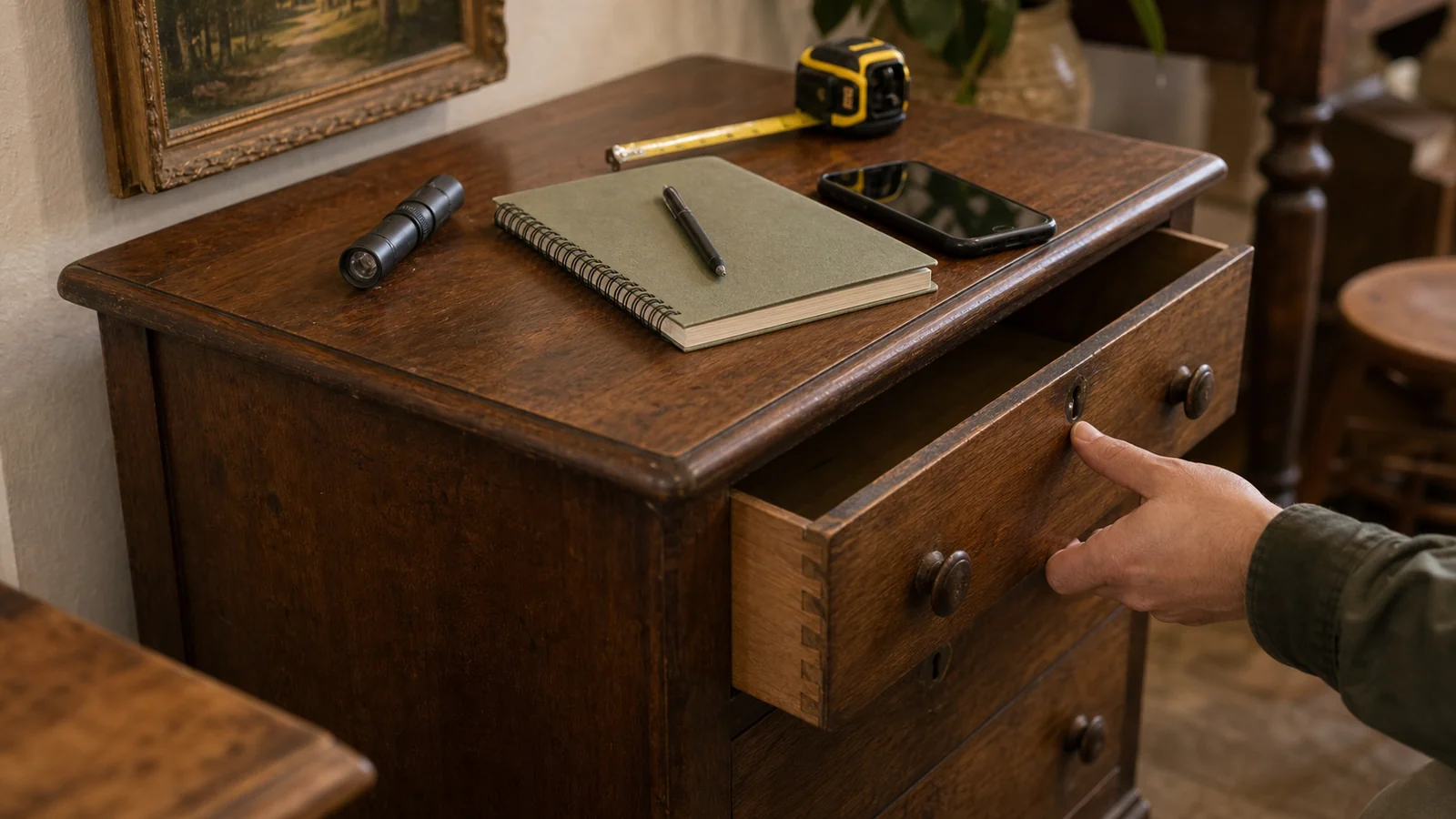
Step 4: Open everything that opens
Drawers, doors, drop fronts, leaves, lids, and sliding panels reveal more than the outside finish. Open them slowly and listen.
Look for:
- Drawers that stick or twist.
- Drawer bottoms that sag.
- Missing runners or stops.
- Doors that rub or will not close.
- Hinges pulling from the wood.
- Locks without keys.
- Loose knobs or mismatched screws.
- Table leaves that do not sit flat.
- Storage interiors with stains or odor.
Do not force anything. If a drawer is jammed, ask the seller before pulling harder. A sticky drawer may be easy to tune. A broken runner, warped case, or swollen wood can become a repair project.
In a compact room, storage furniture earns its place only if the storage works. A dresser with beautiful fronts but frustrating drawers is not a daily-use piece.
Step 5: Smell before you buy
Odor is one of the most important antique furniture checks for small homes. A musty cabinet, smoke-heavy chair, perfumed drawer, or damp-smelling trunk can affect the whole room.
Smell:
- Inside drawers.
- The back panel.
- Upholstery.
- Undersides.
- Closed cabinet interiors.
- Any fabric, cane, or paper lining.
Some light old-wood scent is normal. Strong mildew, smoke, pet odor, mothball smell, or chemical perfume deserves caution. Odor can sometimes improve with cleaning, sunlight, ventilation, activated charcoal, or professional help. It can also linger for months.
If the piece would sit near clothing, bedding, dishes, or a sofa, be stricter. Small spaces do not dilute smell well.
Step 6: Inspect joints, veneer, and repairs
Age marks can be lovely. Structural problems are different. Bring a small flashlight and use it.
Check:
| Area | What to look for |
|---|---|
| Chair joints | Movement, cracking, fresh glue, loose stretchers |
| Tabletops | Splits, deep water rings, uneven leaves |
| Veneer | Lifting, bubbles, missing edges, patched sections |
| Drawers | Loose fronts, sagging bottoms, rough runners |
| Legs and feet | Cracks, repairs, replaced parts |
| Hardware | Missing pulls, stripped screws, sharp edges |
| Back panels | Warping, damp marks, pest evidence |
A good repair can be part of a piece’s history. A bad repair can hide risk. Look for glue squeeze-out, mismatched wood, shiny new screws in stressed joints, or surfaces that move when they should not.
If the piece needs work, decide whether it is a repair you can honestly handle. Our furniture repair guide can help you decide when to fix and when to walk away.
Step 7: Treat upholstery as a separate decision
Antique upholstered furniture can be beautiful, but fabric, padding, springs, and smells add uncertainty. A small apartment gives upholstery nowhere to hide.
Before buying an upholstered chair, bench, stool, headboard, or settee, check:
- Seat firmness.
- Frame movement.
- Sagging or broken springs.
- Stains.
- Odor.
- Fabric wear at arms and edges.
- Loose trim.
- Dust under cushions.
- Whether reupholstery would cost more than the piece.
Do not assume you can easily clean every fabric. Some older upholstery may need professional work. Reupholstery can be worthwhile for a high-quality frame, but it needs budget, time, fabric choice, and transport. For small homes, a wood case piece is often simpler than a soft piece with unknown padding.
If you love the shape but dislike the fabric, price the reupholstery before buying. The chair is not a bargain if the real project costs more than your room can justify.
Step 8: Compare patina with daily use
Patina is part of why antique furniture feels alive. Soft finish wear, darker hardware, small dents, and color variation can make a room feel less flat. But daily-use pieces need different tolerance than decorative pieces.
Patina may be welcome on:
- A side table with light surface wear.
- A mirror frame.
- A cabinet side that faces a wall.
- A stool used as a plant stand.
- A small chest in an entry.
Damage may be a problem on:
- Dining surfaces that need to clean easily.
- Desks used with a laptop.
- Dressers used every morning.
- Chairs that need to hold weight.
- Storage pieces near clothing.
- Anything with active flaking, rough edges, or odor.
Ask yourself how often you will touch the worn area. The more contact a surface gets, the less romantic damage becomes.
Step 9: Check style weight in your room
Antique furniture often has deeper color, thicker wood, carved detail, darker hardware, or a more formal shape than newer apartment furniture. One piece can make a room feel grounded. Several heavy pieces can make it feel crowded.
Before buying, imagine the piece with your current:
- Flooring.
- Wall color.
- Rug.
- Curtains.
- Sofa or bed.
- Lighting.
- Storage needs.
- Walking paths.
A dark chest can look beautiful against warm white walls and pale textiles. It may feel too heavy beside a dark sofa and busy rug. A small writing desk can soften a bedroom. A tall cabinet may block light. A pair of antique chairs may add character, but six mismatched heavy chairs may overwhelm a small dining corner.
For Soft Room Edit rooms, we usually like one antique anchor with enough quiet space around it.
Step 10: Confirm price, hold, and delivery terms
Nearby does not always mean easy. Antique furniture may be final sale, vendor-owned, held only briefly, or pickup-only. Confirm terms before payment.
Ask:
- Is the piece final sale?
- Can it be held while you measure at home?
- Is delivery available?
- Who carries it up stairs or into elevators?
- Is the piece wrapped for transport?
- What happens if it is damaged during delivery?
- Can the seller remove a mirror, top, or hardware for safer moving?
- Is the price firm or negotiable?
- Are there extra fees or taxes?
If you must hire a mover, include that cost before judging the price. A local piece may still be expensive once pickup, stairs, repair, and cleaning are included.
A field checklist for antique furniture near you
Before you buy nearby antique furniture, confirm:
- The piece solves one real room need.
- Width, depth, height, and open-use clearance fit.
- It can pass through doors, stairs, elevators, and halls.
- It sits level and feels stable.
- Drawers, doors, leaves, or lids work.
- Odor is mild enough for your room.
- Joints, veneer, hardware, and repairs are acceptable.
- Upholstery does not hide a larger project.
- Patina suits the way you will use it.
- Delivery, hold, and return terms are clear.
Antique furniture near you can be the best kind of local find: inspected in person, rich with character, and ready to soften a compact room. Let proximity start the search, but let the checklist decide. A piece earns its place when it fits the room, works every day, and brings age without bringing avoidable trouble.
You might also like
Antique Furniture for Small Rooms: Buy One Well
Choose antique furniture for a small room by checking age, scale, structure, repairs, care needs, and how it mixes with modern pieces.

Ashley Furniture Mattress: Small-Bedroom Guide
Choose an Ashley Furniture mattress by checking size, height, support, delivery terms, and how the bed fits your room.
Ashley Furniture Couch: Small-Room Buying Guide
Choose an Ashley Furniture couch by checking width, depth, arms, upholstery, delivery terms, and how it fits your room.