Leather Ottoman Furniture: Small-Space Buying Guide
Start with the job the ottoman needs to do
Leather ottoman furniture can be a footrest, coffee table, extra seat, storage box, bench, or quiet anchor in a small room. That range is useful, but it also makes the decision easy to blur. A leather ottoman that looks beautiful online may still be wrong if it blocks the sofa path, feels too hard under your feet, or needs more care than your household will give it.
For compact homes, choose the job first. Then choose the shape, leather type, and details that support that job.
This is a review-style buying guide, not a hands-on test of one ottoman. Use it to compare leather ottomans, faux leather storage pieces, benches, poufs, and cocktail ottomans through a small-room lens.
Match the shape to your layout
Ottomans look flexible because they do not have backs or arms. In practice, their shape still controls how the room moves.
Use this quick match:
| Shape | Best small-space use | Watch out for |
|---|---|---|
| Square ottoman | Sofa footrest, flexible seat, compact coffee table | Can feel blocky in narrow rooms |
| Rectangular ottoman | End-of-bed bench, sofa table substitute, hidden storage | Needs clear walking space at both long sides |
| Round ottoman | Softens corners and tight seating groups | Storage access may be smaller |
| Cube ottoman | Extra seat, under-console storage, paired footrests | Can look casual if the leather is shiny |
| Leather bench | Entry, bed end, window wall, dining substitute | Depth matters more than length |
Before choosing, tape the footprint on the floor. Sit on the sofa. Stand up. Walk to the door. Open the closet. If the taped shape makes daily movement awkward, the ottoman is too large or the wrong form.
Our ottoman furniture guide can help if you are still deciding between an ottoman, bench, pouf, or coffee table.
Keep the height close to the seat
The easiest way to make a leather ottoman feel wrong is to ignore height. A footrest should usually sit close to the sofa or chair seat height, often a little lower. If it is too tall, your knees lift. If it is too low, your legs drop uncomfortably.
For a coffee-table role, height depends on how you use the surface. A firm leather cocktail ottoman with a tray can work in place of a hard table, but the top still needs to be reachable from the sofa. A soft, domed, tufted ottoman may be lovely for feet and poor for mugs.
Check:
- Overall height.
- Seat or top firmness.
- Whether the top is flat enough for a tray.
- Clearance between sofa, ottoman, and TV furniture.
- Whether legs or casters change the usable height.
- Whether the ottoman slides on your floor.
If the ottoman will sit at the end of a bed, leave enough room to walk past it and sit briefly. A narrow bench may work better than a deep cocktail ottoman in a small bedroom.
Decide between real leather and faux leather
Leather labels matter. Genuine leather, top-grain leather, corrected leather, bonded leather, faux leather, vegan leather, PU, and vinyl do not age or clean the same way. Product pages can also use soft language, so read the material line carefully.
Real leather usually has natural variation. Some types develop more character with use, while more corrected finishes look more even. A leather ottoman in a small room will be touched often, so marks, shade shifts, scratches, and softening are part of the decision.
Faux leather can be easier to wipe at first and often costs less. It can also peel, crack, or feel warmer against skin depending on quality. It may be practical in an entry or guest room, but you should still check heat, sunlight, and cleaning guidance.
Ask yourself:
- Do you want natural character, or a more uniform surface?
- Will scratches bother you or feel lived-in?
- Are pets, children, shoes, or food part of the room?
- Does the listing name the material clearly?
- Is the care guidance realistic for your habits?
- Can you see or order a swatch?
For a daily-use living room, vague material wording is a reason to slow down. A compact room gives one ottoman a lot of attention, so the surface should be something you understand before it arrives.
Use storage only when it stays easy
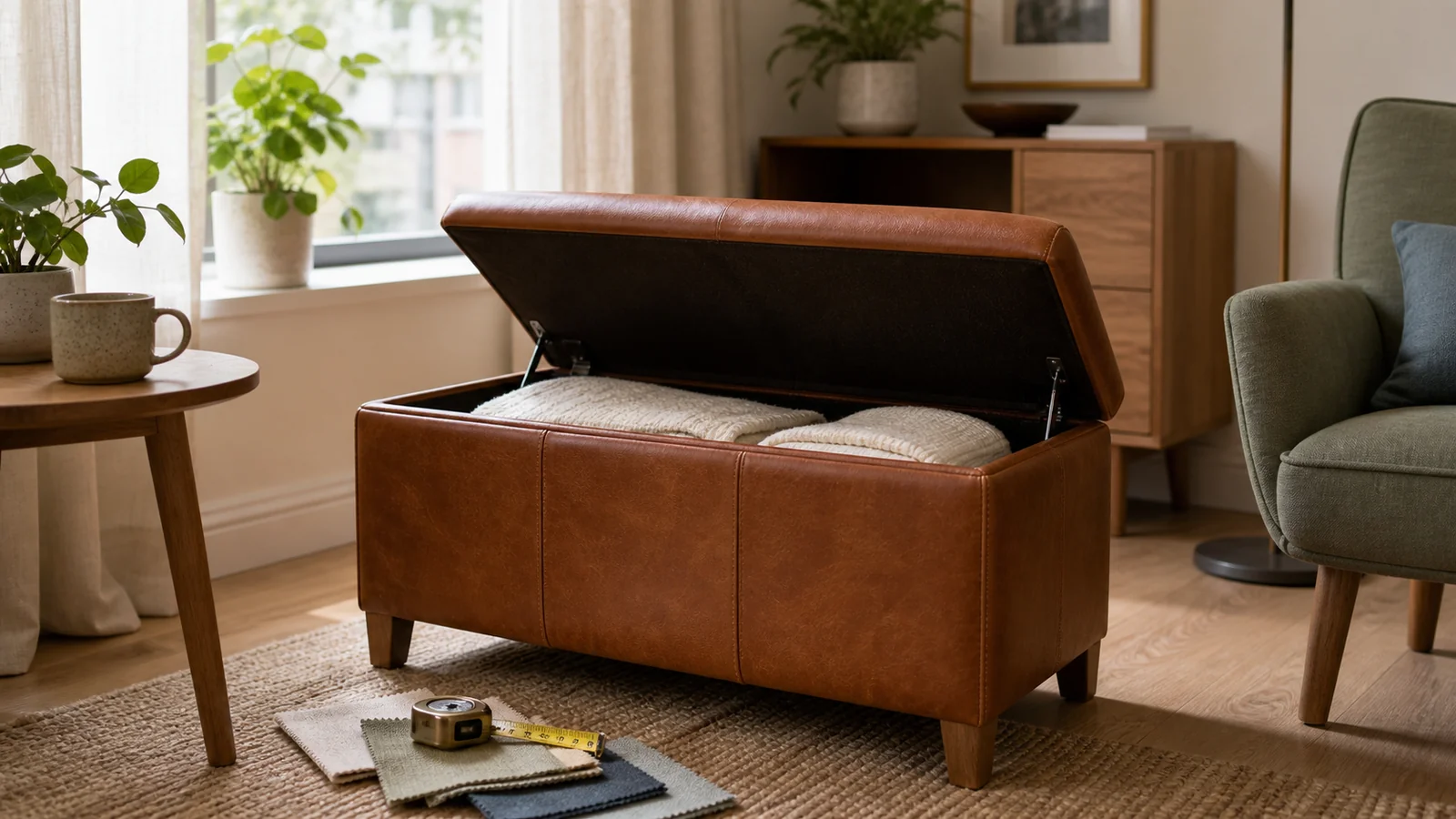
Storage ottomans are tempting in small homes. They can hide throws, guest bedding, remotes, toys, pet supplies, or off-season cushions. But hidden storage only helps if it is easy to open, reach, and keep tidy.
Look at the lid first. A hinged lid may feel more stable, but it needs space to open. A lift-off lid may be simpler, but you need somewhere to put it. A reversible tray lid can be useful for drinks, but it may rattle or feel less soft as a footrest.
Good storage questions include:
- Does the lid open without hitting the sofa?
- Can you reach inside while seated nearby?
- Is the interior lined or rough?
- Are the hinges sturdy and protected?
- Can the ottoman hold real blankets, or only small items?
- Does storage make the piece heavier to move?
- Will the top stay comfortable after daily opening?
If you need daily access, choose a lid you can open with one hand. If the storage is for seasonal items, a heavier bench may be fine. Do not choose storage only because it sounds efficient. Choose it because it supports how the room actually works.
Watch visual weight in dark leather
Leather ottomans often come in black, espresso, cognac, caramel, taupe, cream, and gray. In a small room, color affects visual weight as much as size.
Black leather can look sharp, but it can also pull the eye downward and make the floor feel crowded. Dark brown can feel warm and classic, especially with wood and linen. Cognac leather can add softness and age well visually, but it may dominate a pale room if the ottoman is large. Cream or taupe leather feels lighter, though it can show denim transfer, scuffs, and spills more quickly.
Balance the ottoman with nearby textures:
- Pair shiny leather with matte wood, wool, or linen.
- Pair dark leather with lighter curtains or a pale rug.
- Pair cognac leather with muted green, warm white, or blue-gray.
- Avoid stacking leather sofa, leather ottoman, leather chair, and glossy tables in one small zone.
- Add a tray or folded textile only if the top still has room to breathe.
The goal is not to hide the leather. It is to let it look intentional rather than heavy.
Check seams, legs, and underside details
Ottomans take pressure differently from chairs. People put feet on them, sit on them, set trays on them, move them with their knees, and sometimes store heavy things inside. The construction details deserve attention.
Inspect or ask about:
- Frame material.
- Weight capacity if the ottoman will be used as seating.
- Stitching along corners and lid edges.
- Tufting depth and whether crumbs collect there.
- Leg attachment and floor protection.
- Whether casters lock or roll too easily.
- Interior hinges on storage models.
- Whether the underside has fabric, glides, or exposed staples.
For small homes, mobility can be a real feature. A lighter cube that moves easily may suit a studio better than a heavy cocktail ottoman. A bench with secure legs may suit an entry better than a soft pouf that collapses under shoes and bags.
Plan care before it becomes a stain
Leather and faux leather both need calm, specific care. The safest first habit is simple: keep the surface dusted, blot spills quickly, and avoid soaking the material. Many care guides recommend checking the exact leather type before using cleaners or conditioners, because top-grain leather, nubuck, synthetic leather, and protected finishes can react differently.
For a small room, place the ottoman where it is not pressed against heat vents, radiators, or strong direct sun. Heat and sunlight can dry or fade leather and can be hard on synthetic surfaces too.
Keep nearby:
- A soft white cloth for quick blotting.
- A tray if drinks will sit on the ottoman.
- Felt pads or glides for the legs.
- The manufacturer’s care instructions.
- A note of the material type for future cleaning.
Avoid guessing with harsh cleaners, baby wipes, alcohol, ammonia, or heavy water. If a stain is serious or the leather is expensive, ask a professional before turning one mark into a larger patch.
Compare the ottoman with the coffee table it replaces
A leather ottoman can make a compact living room softer than a hard coffee table. It removes sharp corners, adds a place for feet, and can double as a seat. But it is not always the better choice.
Choose a leather ottoman when you want softness, storage, occasional seating, or a lower visual line. Choose a coffee table when you need a firm surface every day, eat meals there often, work from the sofa, or want open space underneath.
A tray can bridge the gap. It gives mugs, remotes, and books a stable zone while leaving most of the ottoman soft. Choose a tray with handles and a size that does not cover the whole top.
If your living room is very narrow, two smaller leather cubes may work better than one large ottoman. You can separate them, tuck them aside, or use only one when guests are over.
A small-space leather ottoman checklist
Before buying leather ottoman furniture, confirm:
- The shape supports the room’s real walking paths.
- The height works with the sofa, chair, or bed.
- The leather or faux leather type is clearly named.
- Storage is easy to open and useful enough to justify the weight.
- The color does not make the room feel crowded.
- Seams, legs, hinges, and underside details look durable.
- Cleaning instructions match your household.
- The ottoman has one clear main job.
Leather ottoman furniture can be a strong small-space piece when it earns its footprint. Let scale, material, and daily use lead the choice. Then the leather becomes a warm, useful layer instead of one more object sitting in the path.
You might also like
80-Year-Old Furniture Business Closing: Shop Carefully
Use a furniture business closing sale carefully by checking dimensions, final-sale terms, delivery, damage, and room fit.
Meridian Furniture: Small-Room Buying Guide
Evaluate Meridian Furniture for compact rooms by checking scale, upholstery, shine, delivery, storage, and visual weight.
Galleria Furniture: Small-Room Shopping Guide
Use a Galleria Furniture search to compare store identity, showroom scale, delivery terms, and compact furniture fit.